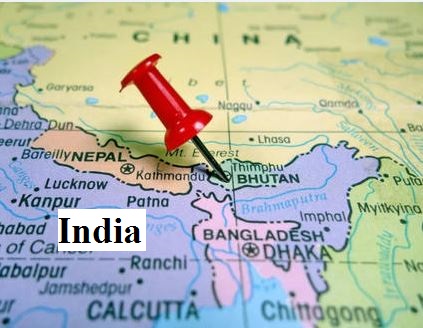
Where is Bhutan on the world map, and is it important for travelers traveling to Bhutan? Located in the Himalayas between India and China, Bhutan is a small landlocked country with stunning mountain scenery and a unique, deeply spiritual culture. With its diverse geographical regions and traditional governmental system, Bhutan has been able to protect its environment and cultural heritage for centuries.
Bhutan is located in South-Central Asia, between India and China. The country’s northern border is defined by the Xuigiang Range of the eastern Himalayan Mountains, while it is bounded to the south by the Brahmaputra River Valley.
Where is Bhutan in the eastern Himalayas? It is sandwiched between China to the north and India to the south, west, and east. It lies between latitudes 26°N and 29°N and longitudes 88°E and 93°E. The terrain consists mostly of steep and high mountains. Elevation rises from 200 m in the southern foothills to more than 7,000 m in the north.
Where is Bhutan on the world map, or where does it lie or is it located?… will be a question to every visitor. Location of Bhutan in Asia on the Eastern Himalayas. From the low elevation of 200m, alpine shrubs, and meadows reach up to glaciated mountain peaks. Most of the Bhutanese peaks cross over 7,000 m above sea level.
The nearest country to Bhutan is India. With India, it is easy to travel to Bhutan. The border is porous, and it is easy. Trade relations with India are easier than with Nepal, Bangladesh, and China.
Slowly, the introduction of flights to Bhutan made it easier to locate Bhutan with countries like Bangladesh, Nepal, Singapore, and Thailand.
Bhutan was isolated from the rest of the world. It became less isolated in the second half of the 20th century. The road construction from Phuentsholing to Thimphu made Bhutan open to the rest of the world.
The governmental structure and functioning got better day by day. Major reforms initiated by the 3rd King Jigme Dorji Wangchuk in the 1950s and ’60s led to a shift away from absolute monarchy in the 1990s. Finally, the fourth king, Jigme Singye Wangchuk, led the institution of multiparty parliamentary democracy in 2008.
Where is Bhutan’s capital, Thimphu? The capital of Bhutan lies in the western part of Bhutan. It is the largest city in the country with a population of 250,000. The Bhutanese capital is on the bank of the Wangchu River and is known as the Thimphu Valley. It is one of the districts, or Dzongkhang, among the 20 districts of the country. The capital city of Thimphu, Bhutan, was replaced by Paro in the year 1955. It was officially declared by the 3rd king of Bhutan, Jigme Dorji Wangchuck, in 1961.
The Dzongkhag, or district, has its own administration and judiciary system, centralized by the central administration in Thimphu under the Royal Government of Bhutan. The administrative system in Bhutan is divided into 20 separate Dzongkhags, or districts, in Bhutan. The Local Government Act of 2009 established local governments in each of the 20 Dzongkhags overseen by the Ministry of Home and Cultural Affairs.
Each district is under a Dzongda, or district head, who heads all sectors like health, education, agriculture, culture, economics, and so on. Each sector head is headed by a civil servant. Further, it is divided into smaller counties known as “Gewogs,” with 205 Gewogs in Bhutan.
Each Dzongkhag has its own elected government with non-legislative executive powers, called a Dzongkhag Tshogdu (district council). The Dzongkhag Tshogdu is assisted by the Dzongkhag administration headed by a Dzongdag (royal appointees who are the chief executive officer of each Dzongkhag).
Bhutan, with a total area of 38,394 square kilometers, or around 14,824 square miles. There are approximately 477 kilometers of border with China in the north. With approximately 659 kilometers in the south, west, and east with the states of Arunachal Pradesh, Assam, West Bengal, and Sikkim of India. Bhutan’s total borders measure 1,139 kilometers. Bhutan, with one of the smallest populations per square kilometer in the world, has a government policy written in the constitution of Bhutan of maintaining at least 65-70 percent of forest cover.
The current population of Bhutan is 792,511 as of January 25, 2023, based on United Nations data. The population of Bhutan is projected at 771,608 for the year 2020. Bhutan ranks 165th in the world by population. Bhutan is ranked 48th among 51 countries in Asia.
The population of Bhutan is projected to reach 842.7 thousand in 2030, increase further to 904.6 thousand in 2050, and fall to 686.0 thousand by 2100. Bhutan has 0.010 percent of the world’s population. Where is Bhutan? on the population ranking? Bhutan was in the 168th position globally in 1950, and its rank is projected to decline further in 2100.
The nation has a literacy rate of around 60%. Women outnumber men by only around 7 percent. Bhutan’s population consists of three main ethnic groups: the Ngalops of Western Bhutan, the Sharchops of Eastern Bhutan, and the Lhotshampa of the southern foothills of Bhutan.
Where is Bhutan? And who are neighboring countries? Another question to be asked by travelers. Bhutan is a landlocked country and is surrounded by only two giant nations, i.e., China in the north and India to the south.
The majority religion of Bhutan is Buddhism. A total of 75 % of the country follows Vajrayana Buddhism, which was introduced to Bhutan in the 7th century from Tibet. About 22 percent are Hindus, and the remaining three percent is split between Bon, Christianity, Islam, and other minor religions.
The national language of Bhutan is Dzongkha. The traditional script in Bhutan is known as Chhokey. Dzongkha is taught as the national language of Bhutan. English is the main medium of instruction in all schools of Bhutan. However, there are also another 22 languages spoken across Bhutan. Nepali is also a widely spoken language. Other dialects include Dzala, Limbu, Tshangla, Keng, Rai, and so on, which make up around 45 percent of the spoken languages in Bhutan.
Geography of Bhutan, with varying altitudes, with the high Himalayas lying in the north and the low-lying plains to the southern foothills of Bhutan. With an average elevation of around 2,500 to 3,000 meters. The highest peak of Bhutan is Mount Gangkhar Puensum, with an elevation of 7,580 meters, and the lowest point is at Drangme Chhu, with an elevation of 97 meters above sea level.
The currency of Bhutan is the “ngultrum,” and it is pegged with the Indian rupee. The Indian rupee is accepted as legal tender in the kingdom, with denominations of 100 and less. One of the world’s smallest economies, the national economy is growing rapidly, with an annual growth rate of around 22 percent.
The growth of the economy of Bhutan was due to hydropower. Agriculture makes up around 55 percent, 22 percent is given to industry, and only around 1.8 percent is attributed to tourism.
The food of Bhutan, or Bhutanese cuisine, mainly consists of red rice, buckwheat, and maize. Pork, beef, chicken, lamb, and yak meat are also eaten. Soups and stews of Bhutan are often made from meat and dried vegetables, spiced with chilies, and have cheese added.
Most of the dishes in Bhutan are very spicy, with a heavy use of hot chilies. Dairy foods, including butter, milk, and yogurt, from yaks and cows are daily foods for most Bhutanese. The most popular beverages are tea, in the sweet Tibetan form, as well as traditional Tibetan butter tea.
Bhutan is known for its dramatic geography, with high mountains, steep valleys, and deep gorges. The country is also home to the world’s highest peak, Mount Everest, and is a popular destination for mountain adventurers and hikers. Bhutan is also home to a variety of beautiful forests, lakes, and rivers, as well as a variety of rare and endangered wildlife.
Bhutan Tours & Trekking offers a variety of tour packages that allow visitors to experience the country’s natural beauty and cultural heritage. Some of the most popular tour packages include the Bhutan Shortest Tour, the Western Bhutan Tour, and more.
Traveling to Bhutan: Where is Bhutan? Accessibility is easy if you contact it directly instead of contacting a third party. It is more accessible from Bangkok, Thailand, because of daily flights to Bhutan. The second would be India because Bhutan flights are connected to Kolkata and New Delhi with Druk Air and Bhutan Airlines. Kathmandu would be another alternative route to travel to Bhutan if you are coming to Nepal first. Singaporeans can fly directly to Paro, Bhutan. The last route would be from Dacca to Bangladesh. No international flights fly in and out of Bhutan.